Publisher: Philomel Books, 1994
Editor: Patricia Lee Gauch
Art Director: Nanette Stevenson
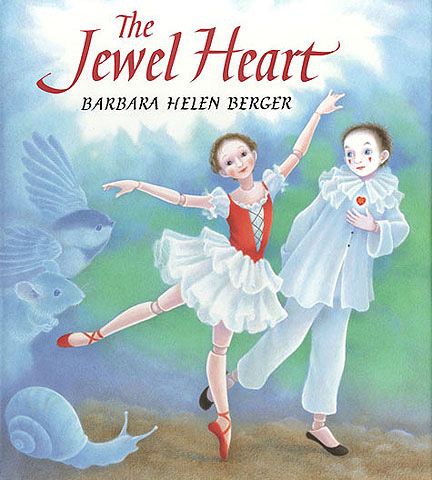
On a small stage on the forest floor, two dolls play out their story. Gemino gives his song to Pavelle with the only voice he has, his violin, and she cannot dance without him. But one day Gemino is lost, and Pavelle sets out to find and then to fix her broken friend if she can. A story of the healing power of love.
Author’s comments:
Facing the title page, an audience of small animals (a toad, chipmunk, chickadee, snail, two mice, a moth, and others) waits in front of a stage with red curtains. The curtains part as the story begins, and we meet Gemino and Pavelle. The audience animals become blue “shadows” who are now part of the story too. They move in and out of the picture frames through the rest of the book.
I loved ballet as a child, and wanted to be a ballerina. In this story, Pavelle the dancer is proud and demanding at the beginning. But by the end she is humbled and softened by the loss of Gemino, by her transforming work of fixing him (with the shadows’ help), and her own love for him.
At the very end of the book there is a wordless denouement: the curtains of the little stage have closed, the audience of animals who entered the story have all gone home, and small flowers are blooming around the stage where there were none before.
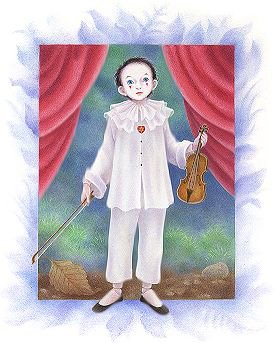
“Gemino had a jewel for a heart.”
Reviews of THE JEWEL HEART
Publishers Weekly
*starredreview*
August 22, 1994
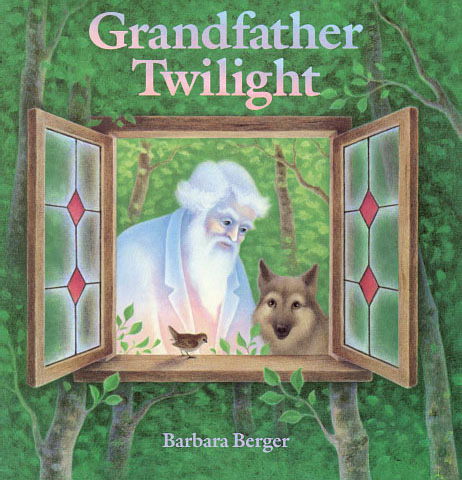
Borrowing classical stage traditions for its themes and characterizations, this original tale speaks of unrequited love and romantic transformations. The voiceless Gemino, a Pagliacci-style clown, has only a jewel for a heart. He plays his violin for his beloved ballerina, Pavelle, whose appreciation for him seems to end with his haunting music. But when Gemino lies listless in a heap after a tragic fall, Pavelle is desperate to “fix” him. Aided by the animal shadows, she stitches new clothes (with a spider’s web for thread and a thistle’s spine for a needle) and patches him together. But Gemino needs a new heart. The shadow spirits offer a “brown seed … dull and plain.” Pavelle plants it in Gemino’s chest, her tears watering it. When Gemino wakes and plays a new song, a living bud replaces his jewel heart. It is, however, Pavelle who has changed most. The style and soft palette of Berger’s (Grandfather Twilight) acrylic paintings exude the familiar prettiness of a fairy tale, but her dramatic storytelling and gossamer imagery elevate the work to the elegance of opera or ballet. A substantial story that will blossom with repeat readings. …
Booklist
September 1994
… With the same luminous palette of blues and greens and the same serene, poetic style she used in Grandfather Twilight … Berger paints a mystical woodland scene to stage her story. A soft dream spun of song and dance, this sweetly evocative picture book about the power of love will enchant young ballerinas who yearn for something magical.
—Annie Ayres
School Library Journal
October 1994
… A gentle story of the healing power of love, this will appeal to those young listeners who can leave the world of logic behind and willingly step into the realm of fantasy. … As with Berger’s Grandfather Twilight … nature plays a prominent role. … [The] pastel tones contrast strongly with the primary red of the young woman’s costume, adding an ethereal, magical quality to the work. Reminiscent in mood of Margaret Wise Brown’s Wait Till the Moon Is Full … the book can be used with a group but is better for one-on-one sharing.
—Nancy Menaldi-Scanlan, Wheeler School