Publisher: Philomel Books, 2000
Editor: Patricia Lee Gauch
Art Director: Cecilia Yung
Designer: Gunta Alexander
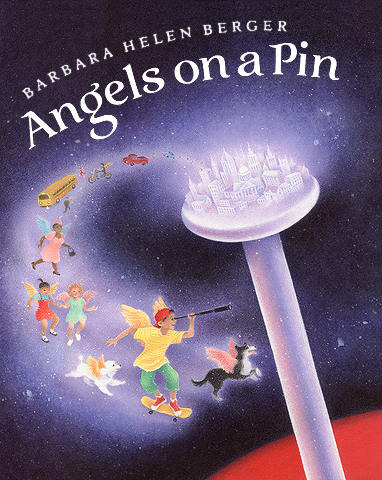
There is a famous old question: How many angels can dance on the head of a pin? Long-ago philosophers used to ponder that. Ideas still come from asking questions. ANGELS ON A PIN begins with one we can ask any time: What if?
What if there was a city on a pin?
What if it was no bigger than a speck of dust?
But the people who lived there didn’t know that.
To them, it was the biggest, the best, the only city in the world.
Author’s comments:
When I was a child, my mother often shared her own musings with me. One day she said, “What if our whole world is only an atom in the leg of a stool in some other universe?” Hmm. Trying to imagine that was mind-boggling for me. But it was also fun. It sparked a life-long delight in the idea of worlds within worlds, the play of microcosms and macrocosms. And that is where this book came from.
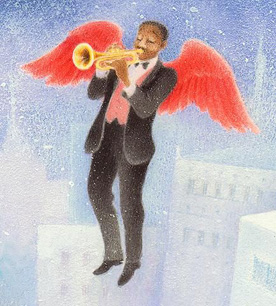
“To celebrate, the mayor blew his trumpet.”
Reviews of ANGELS ON A PIN
School Library Journal
PreSchool-Grade 1-A story that ponders the nature of existence in an entire city atop the head of a pin. The winged inhabitants of the pin-top metropolis wonder if there are worlds beyond their own, until a resident spies another community on a neighboring pin. The din from the celebration of their mutual discovery is heard throughout the universe and even more civilizations respond from all over the pincushion and beyond. This revelation helps people to realize that, “Hey wow, look! We’re not alone!” Fanciful acrylic, colored-pencil, and pastel illustrations depict a benign multiethnic cast living in pastel-shaded worlds offset by backdrops of deep blues and blacks. While the whimsical yet mysterious pictures will appeal to youngsters, the spare text may leave listeners wishing for more. Fairly deep philosophical concepts are touched upon in this light picture-book romp, creating a certain dissonance between topic and treatment. Children, however, may be oblivious to such considerations and enjoy the book as a light confection as suggested by the visual presentation.
—Rosalyn Pierini, San Luis Obispo City-County Library, CA
Publishers Weekly
Berger (Grandfather Twilight) offers a pretty but vacuous riff on the originally satirical question “How many angels can dance on the head of a pin?” by positing dreamy worlds within worlds of tiny, pin-dwelling angels. Her story opens with the question, “What if there was a city on a pin?”; the accompanying art shows a small-town street, with people and pets—all of them with wings, apparently angels. In the foreground, an elderly woman angel sees a pincushion in a dressmaker’s window. The next pages home in on the pincushion, where the head of each pin is the site of a whole city of tiny angels. The plot is thin to the point of brittle: the angels on the pin-city think theirs is the only one in the world, then a child using a telescope spies another city on a pin, contact is made and a celebration begins. Berger’s mixed-media paintings create a light and lively atmosphere where angels of all ages and nationalities boogie-woogie (“Shimmy shimmy hip hop, and cha-cha-cha”) in mid-air, rejoicing, “Hey wow, look! We’re not alone!” The framing story reprises this theme, returning to illustrations of the elderly woman, now joined by a dapper old gent in a top hat—and, suggesting the circularity of the premise, a child can be seen gazing through a telescope. Given that Berger makes no particular use of the angel motif (these could just as well be miniature people), the net effect is that of an extended daydream. Ages 4-8. (Feb.)
Kirkus
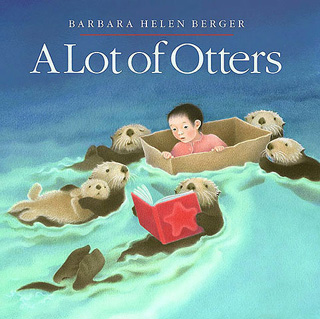
“What if there was a city on a pin?” Berger (A Lot of Otters, 1997, etc.) asks curiously (if ungrammatically) in this fanciful musing. The city is no bigger than a speck of dust on the head of a pin, but for its inhabitants, it is all there is, and sometimes it makes them lonesome. Then they find another city, travel there, and the boogie-woogie begins: bebop, shimmy, cha cha cha. The cityscapes look like as if they are made of pastel spun sugar, and the figures are recognizably skateboarders, bikers, church ladies, children but they all have wings. The mayor, refulgent in his formal dress, has red wings, a black-and-white dog has pink ones, and the two-stepping cowpokes sport green and gold ones. All this dancing takes place in the streets, above the buildings, and in the lapis-colored, starry sky between the cities. The book’s message that we are not alone isn’t hammered but sort of tapped gently. The question, “How many angels can dance on the head of a pin?” is as least as old as Aquinas and forms the colophon here, leading readers into a dream-scented landscape. (Picture book. 4-8)