Publisher: Philomel Books, NY, 1997
Editor: Patricia Lee Gauch
Art Director: Cecilia Yung
Designer: Donna Mark with BHB
Awards and Honors:
1998 Children's Book Award, Pacific Northwest Booksellers Association;
Chosen as a Best Book of 1997 by School Library Journal;
Selected for “The Original Art 1997, Celebrating the Fine Art of Children’s Book Illustration,” exhibition sponsored by the Society of Illustrators, New York.
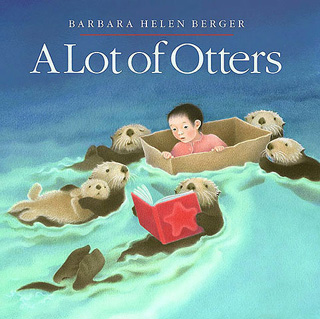
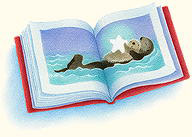
A toddler in pajamas sails off in a box with his book, and the story in his book unfolds around him. He meets the sea otters who dive for fallen stars under the sea, carry them up and cavort with the stars, causing “such a commotion of light,” that Mother Moon looks down. There she finds her own child, the toddler in the box, “safe with a lot of otters, in a sea of stars.”
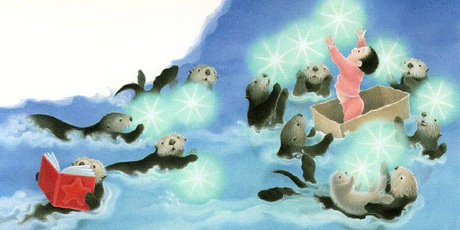
“They made such a commotion of light…”
Author’s comments:
When the toddler, Moonlet, climbs into his cardboard box, the blue shadow under the box turns into water, and as he reads his book he sails away. From then on, everything takes place in that fantasy water, painted with washes of blue to flow from page to page.
The sea otters are based on careful observation (in Aquariums, videos and books). So their activities reflect what sea otters actually do – the way they dive, the way they carry their food up, the way they eat, groom, play. But here, they are playing with stars, and one otter is reading Moonlet’s book from the moment he drops it (“Oops”) to the very end.
In a picture book, I like showing something in the art that is never mentioned in the words but is an integral part of the story. Here, the cardboard box and the toddler’s book with its red cover are never mentioned. Nor is the otter who keeps on reading that book while everything goes on around him. Then, if you lift off the dust jacket on the real book (in hardcover), you will see the cover underneath is the same as the book in the story: red with a star.
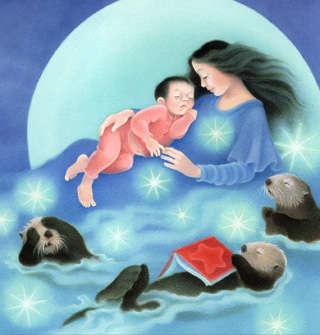
“… in a sea of stars.”
Reviews of A LOT OF OTTERS
School Library Journal
September 1997
*starred review*
… PreS – In this gentle, lovely fantasy, a winsome toddler climbs into a cardboard box, book in hand, and sails off into a nighttime encounter with a band of otters. Spare lines of text follow the reading child out onto the water, where the book falls overboard, soon to be retrieved by the curious otters, some holding their own babies. The unseen Mother Moon weeps tears that fall as stars on the drifting crowd, and soon all are caught up in diving and grasping these glittering objects. Berger’s softly drawn otters are comical and appealing as they cavort through the blue and green water swirling across the double-pages, playing with the stars and picture book and reaching out to the baby in his box. Mother Moon finally notices the commotion and is reunited with her child in the star-filled sea. Moon Mother and her sleeping moonlet, surrounded by drifting sleepy otters, are framed by a pale green moon for the quiet conclusion. The child in soft red pajamas, his red jacketed book telling also of moon and stars, and the tan cardboard box are both playful and familiar touches, grounding the scheme in the real world as it pushes easily into dreamland. The deft flow of words and pictures and the universal theme of the venturing child and anxious mother reunited are a satisfying combination, and toddlers are sure to delight in the mischievous antics of all those whiskery otters.
– Margaret Bush, Simmons College, Boston
Publishers Weekly
July 14, 1997
In rhythmic text paired with translucent art, the story of a pajama-clad boy unfolds, as he pushes off to sea in a cardboard boat and reads a book about Mother Moon, who is looking for her lost “moonlet.” But his book falls into the grasp of otters. Here Berger (Grandfather Twilight) deftly divides her tale into two intertwining perspectives: the boy and the otters are reading about their own simultaneous adventure of helping Mother Moon to find her lost child, who is the boy himself. Simple enough for beginning readers, Berger’s text is dreamily evocative: when Mother Moon’s tears fall as stars, the otters “wrestled and rolled and rubbed the starlight into their fur”—making a “commotion of light” to draw Mother Moon’s attention. Berger’s watercolors take on the colors of heaven and sea waltzing in tranquil veils of green and blue. She moves from the intimacy of the orphan in his boat reading, to the expansive heavens from which Mother Moon recognizes her lost moonlet with equal agility. A gentle, lulling reverie to ferry youngsters from bedtime to dreamtime. Ages 2-6.
Kirkus
Sept. 22, 1997
The title may give the impression that this is a counting book; instead, Berger … presents an exquisitely composed and tender fantasy, melding text and pictures so well that one could not exist without the other. She calibrates the pacing of this picture book perfectly: The first page shows a toddler walking with a book; the baby climbs into a box at the title page; at the opening of the real story, the child begins reading the book, about “Mother Moon” looking for her child, her “moonlet.” What the child sees on the picture-book page is the scene readers see; from there, the events are nonstop: The toddler drops the book, and an otter spots it from underwater. That otter reads the book aloud to a group of otters treading water, including one who floats on her back with her baby lying upon her like a fuzzy teddy bear. The moon-mother’s tears fall into the sea, turning into stars – a folktale element that allows for lovely compositions as the otters dive for the stars. Mother and moonlet – who turns out to be the toddler – are reunited. Themes of independence, separation, and reunion are all given play in a book in which sweet otters act like children and look like expertly drafted, favorite stuffed animals, floating and dozing off at the end. (Picture book. 2-6)