Publisher: Philomel Books, NY, 1985
Editor: Ann Beneduce
Art Director: Nanette Stevenson
Award:
Golden Kite Award for Picture-Illustration, Society of Children's Book Writers & Illustrators, 1985
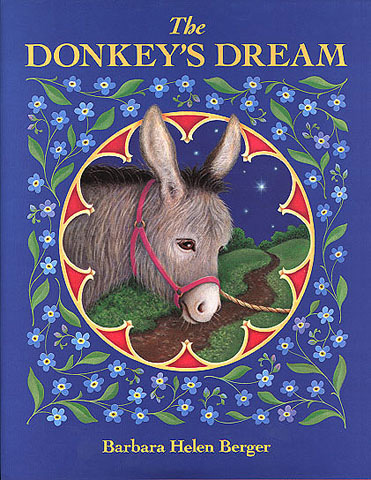
As he walks along, a donkey dreams he is carrying a city, a ship, a fountain, a rose, then a “lady full of heaven” upon his back. When the lady gives birth in a cave, she calls the donkey to her: “See what we have carried all this way, you and I.” A Christmas picture book rich in symbols of the feminine, with an author’s note at the end.
Author’s comments:
The idea for this book came to me in visual images one day, during a meditation. I saw each image carried on the back of a small gray donkey, and later I recognized them as symbols of the great archetypal Mother. Though they were in use before Christianity, these symbols were given to Mary by the Church. The idea of a donkey carrying the sacred feminine in the form of these images, just as he carried Mary to Bethlehem, was a gift of inspiration dropping gently into my lap.
Doing the art for this book gave me a chance to paint my love not only for the Christmas story itself, but for stained glass windows, illuminated books, and the art of great early Renaissance painters like Fra Angelico (whose work had deeply moved me when I studied art in Italy). I wanted the beauty of that heritage to flavor my book.
My hope was for THE DONKEY’S DREAM to be open to anyone, no matter what connection they may or may not feel to the Christian tradition. I wanted the universal quality to come through. So instead of naming the people in the story, I called them only “the man,” “the lady,” and “a tiny baby.”
Parents from other faiths, or from none at all, have told me they are grateful for a story of the sacred side of Christmas that they can comfortably offer to their children. THE DONKEY’S DREAM has found its way into churches, convents and monasteries as well, for Advent and Christmas readings. Many families read it aloud every year.
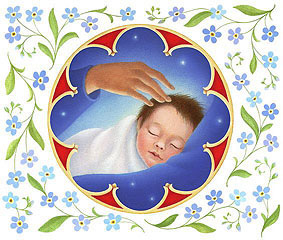
“It was only a tiny child. Yet, when the baby opened his eyes, the cave was full of light.”
Reviews of THE DONKEY’S DREAM
Publishers Weekly
Sept. 13, 1985, pp. 131-132
A little gray donkey, led by a man on a long journey, dreams he’s carrying a wonderful city, a ship, fountain and a rose on his back. The imagined burdens succeed each other until the travelers reach a town where the donkey realizes he’s carrying “a lady full of heaven.” Finding no room where he asks for shelter, the man brings his lady to a cave where Jesus is born. The donkey receives thanks for the family’s safe arrival from the mother who shows him her lovely child, no dream this time, but a baby whose eyes fill the cave with light. Berger’s note explains the traditional Marian symbols (City of God, spiritual vessel, Rosa Mystica, etc.) as fantasized by the donkey. The paintings are glorious, reverent versions of the Nativity in which colors intensify the impact of visions and reality. Delicate borders are composed of forget-me-nots which, the artist tells us, she learned are called in French les yeux de Marie. (All ages)
The Horn Book Magazine
November 1985
… Completely avoiding the sentimentality and saccharinity that often mark such religious presentations, the book is a perfect one for those for whom Christmas is a religious, and not a secular, holiday.
Seattle Public Schools Library Services
March 1986
Books Reviewed By Elementary Librarians and Other Staff Members
… The story is simply but beautifully told. The illustrations are typical of this Northwest artist/author’s rich, distinctive work. A one-paged author’s note at the end explains the symbolism, but does not detract from the dreamlike mood. The binding is suitable for library use and comes in a beautiful dust jacket. This is a picture book which should delight all ages.
New York Times Book Review
December 15, 1985
… The jewel-like pictures are set in decorative frames, as in sections of an altarpiece or an illuminated manuscript. But the donkey’s ear projects from one, doves’ wings and dogs’ tails from others, as though the magical space of the illustrations were united with our own.
—Jane Langton (author of The Hedgehog Boy)
Booklist
*starred review*
(published by American Library Association)
November 1, 1985
… The recurring designs and color schemes add a unifying force. The cobalt blue of the sky is repeated in the pregnant Mary’s star-covered gown; the tiny, light blue forget-me-nots that intwine across the pages are identical to the color in Mary’s eyes. In fact, they are called les yeux de Marie (Mary’s eyes). A final author’s note explains some of the other symbols used. Like the Christmas message itself, this is simple enough for young listeners to understand yet full of complexities for older children and adults to ponder.
Hungry Mind Review
Winter 1995-1996
Nativity Stories
Backlist Column by Kathleen Norris
… A personal favorite is Barbara Helen Berger’s The Donkey’s Dream, with simple yet evocative illustrations that a child could dream on: … This is one of those rare finds; a good read-aloud book that appeals equally to small children and adults. One year I gave it to a Benedictine monastery for Christmas, and the abbot read it to the monks on Christmas eve.